
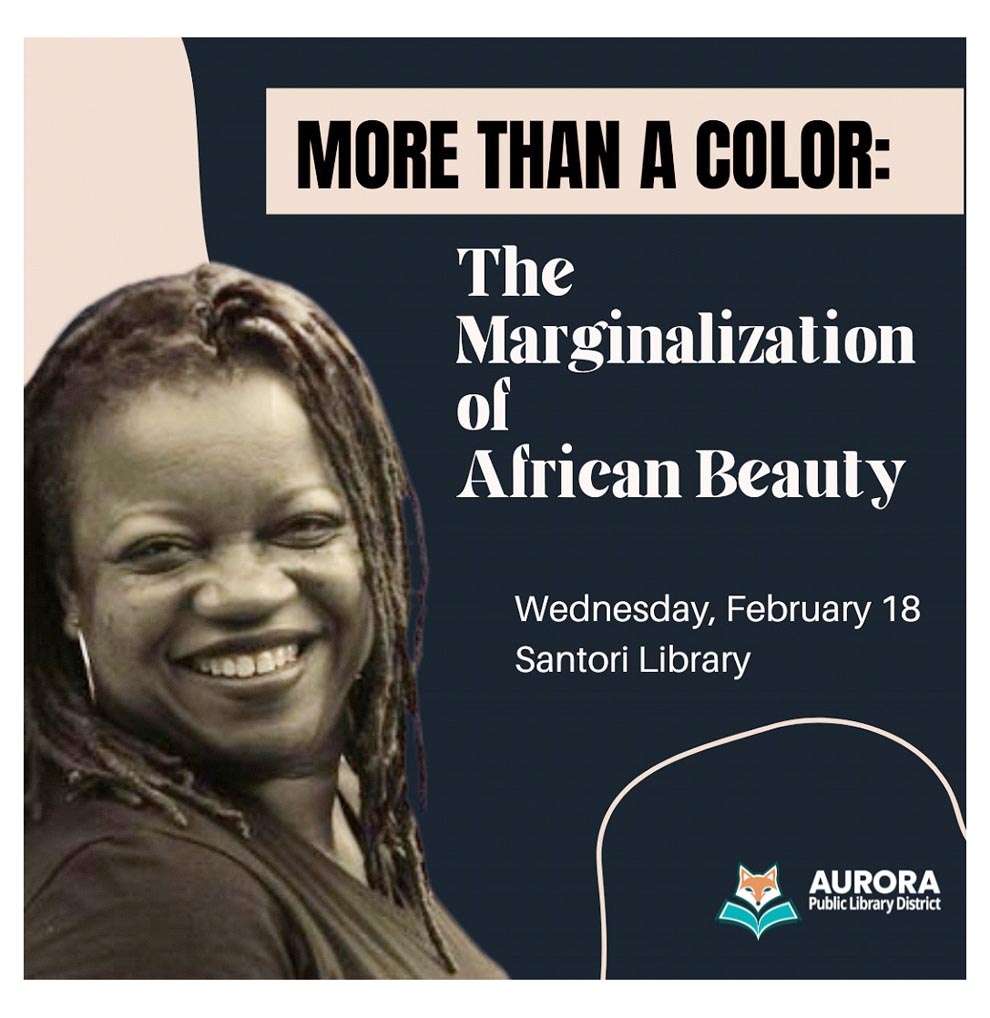
Close your eyes and picture a beautiful person. What color are their eyes? What style of hair do they have? What does their clothing look like? We all have our own opinions, but what standards are these opinions based on? For centuries, darker skin has often been portrayed as “less than,” even amongst people of color. This portrayal has shaped subconscious thinking and impacted how society views beauty and how individuals view themselves. The Aurora Public Library District addresses this concept in the upcoming program, More Than a Color: The Marginalization of African Beauty. There, Illinois Humanities Road Scholar, Karen J. Anderson will explore how traditional beauty standards have often excluded people of African descent and how Black women have continually resisted, redefined, and reclaimed their beauty.
Anderson challenges these ingrained ideas through each aspect of her work. A Chicago-based artist, writer, photographer, filmmaker, and speaker, she emphasizes the importance of embracing natural beauty, seeing women of color represented in television and film, and deciding for oneself what beauty truly means. Her artist statement from uppcreative.com details her mission: “If we tell our own stories, no one can steal our history, or our confidence or our self-worth. My artwork is about telling the stories of the marginalized life and the people who live it. I cover the past, present and future. The images tell stories that can inform to the way of life in the community, uplift with the beauty that comes from the community and educate the rest of the world about the community.”
Generations of African Americans have faced strict rules and laws that dictated how to appear in public, from limiting fine or expensive clothing, to refusing to use Black models on magazine covers. The belief was enforced that beauty was a privilege meant for others. Anderson hopes to inspire change through the stories of women in 1760 French America who found ways to legally free themselves from slavery, only to face new restrictions under government laws. You’ll learn the names Sarah Breedlove and Ann Malone who transformed the beauty industry and reshaped the way women of African descent saw themselves. These women refused to view themselves through society’s oppression and their experiences offer powerful lessons that continue to resonate with audiences today.
It’s important now more than ever to have these conversations about beauty standards and acceptance, especially during critical developmental periods of a young person’s life. “Teaching children and teens to embrace their natural beauty is an act of care,” said senior children’s manager, Monica. “When we talk openly and honestly, we give them tools to build confidence that isn’t dependent on comparison or approval. It helps them understand that they don’t need to be fixed, filtered, or reshaped to be enough—they already are.” Library assistant, Colleen agrees and adds about Anderson, “Her message about how we perceive ourselves and others is important to share with our community.”
More Than a Color: The Marginalization of African Beauty invites you to reflect on the past, recognize lasting impacts, and celebrate the power of defining beauty on one’s own terms. Join us at the Santori Library at 6 p.m. Wednesday, Feb. 18 for this thought-provoking presentation. Registration is requested. Learn more about the event and reserve your spot by visiting www.aurorapubliclibrary.org/event/15335701 or calling the library at 630-264-4117. For additional resources on topics, like beauty and body image, APLD is here to help.
Andrea Tiberi is the communications coordinator for the Aurora Public Library District.