Todd Thorson is on a mission, helping people, especially senior citizens, stay safe, confident and empowered in a fast-changing digital world.
Thorson, founder and chief technology officer at Yorkville-based Tanj Cybersecurity and Technologies, presented “Cybersecurity for Kids Over 60–8 Ways” at Riverview Diner in Montgomery February 17. He was the after-dinner speaker for the monthly membership meeting of Navy League Aurora Council 247.
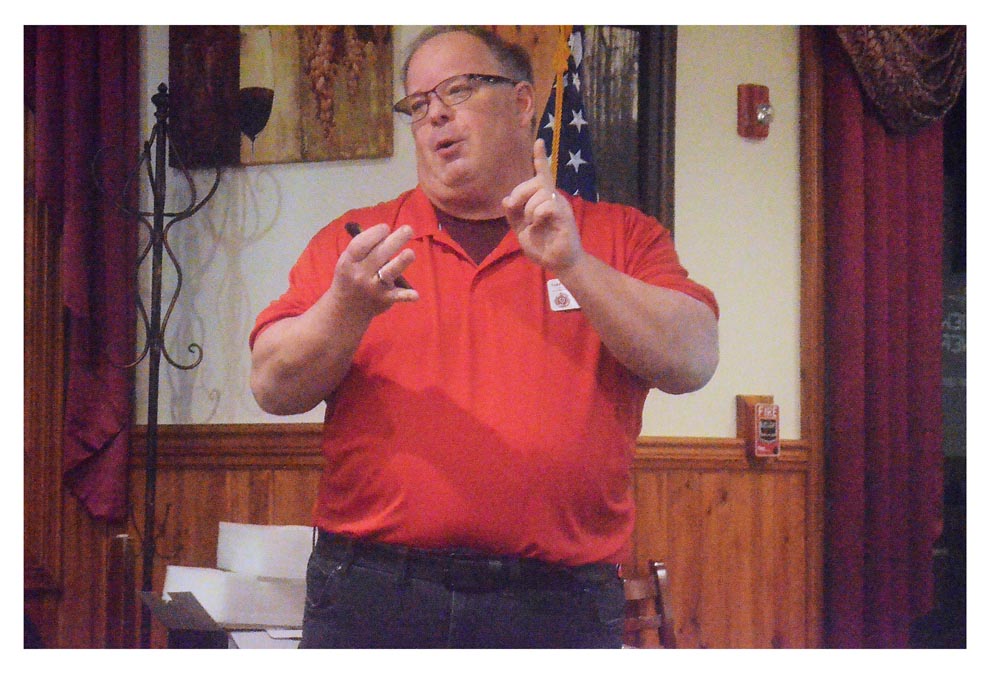
“I’m angry at the level of money being stolen from you,” he told the audience of mostly seniors. An estimated $3.3 billion was stolen from people over age 60 last year, he explained.
Thorson detailed seven most common scams and eight ‘hot tips” for seniors to protect themselves. Scams are:
•Government impersonation: Scammers pose as officials from the IRS, Social Security Administration or Medicare, threatening arrest or loss of benefits unless immediate payment or personal information is provided.
•Sweepstakes and lotteries: Victims are told they’ve won a prize, but must pay fees or taxes upfront to claim it.
•Tech support: Fraudsters pretend to be tech support agents, claiming the victim’s computer has a virus and charging for unnecessary repairs.
•Grandparents: Scammers pose as a grandchild in distress, asking for money to be sent immediately.
•Investments: Fraudulent investment opportunities promise high return with little risk.
•Romance: Scammers build fake romantic relationships online to gain trust and then ask for money.
•Funerals: Scammers claim the deceased owed them money and pressure the family to pay.
Anti-scam strategies provided by Thorson included using multi-factor authentication (MFA), banking and credit card protocols, password safety, family protection, emails and texts, phone calls, social media and quick response to being compromised.
According to Thorson, MFA is a security process requiring users to provide two or more different types of evidence (factors) to verify their identity, significantly reducing unauthorized access risk. It combines knowledge (password), possession (phone/token), or inherence (biometrics) to protect accounts even if one credential is stolen.
“Find a trusted family member or friend to help if needed,” Thorson says. “Lock down all bank, investment and social media accounts.”
Regarding banking and credit cards, Thorson advises to write checks with gel pens, set up a credit freeze and watch for skimmers, illegal card readers. Often disguised as part of a legitimate machine, they capture credit, debit, or EBT card data from magnetic stripes.
Password safety strategies include using at least 12 digits and using a password manager. Examples, he said, are Roboform, 1Password and Dashlane.
For family protection, Thorson recommends holding a family trivia night to write questions only family members can ask if contacted by scammers.
Email and text scams, Thorson said, often include a photo of one’s home and personal information. He says, “Don’t be fooled! Don’t reply or interact, don’t unsubscribe, just delete. Watch for scams with a sense of urgency.”
Phone calls feature a familiar voice or trusted source such as a family member, FBI, Social Security or Microsoft. “Ask for a name and callback number,” he says, “hangup and call someone for help. Use your family trivia questions.”
Social media contains traps. “Don’t do surveys. lists of favorite things or repost the fix-the-system or block-the-ads which require copy and paste.
Finally, “Don’t ignore a compromise to a scam. Act fast. Look for tests in bank accounts.
Thorson answered questions and invited calls to 630-617-5330 for more information.
—Al Benson