
“For me, making art is not a matter of closure, but of continuous renewal,” artist Steve Sherrell shared in his artist statement at Water Street Studios. Steve and his son, Colin, were featured in “Layer Upon Layer,” an exhibit in October 2025 at the Batavia art gallery.
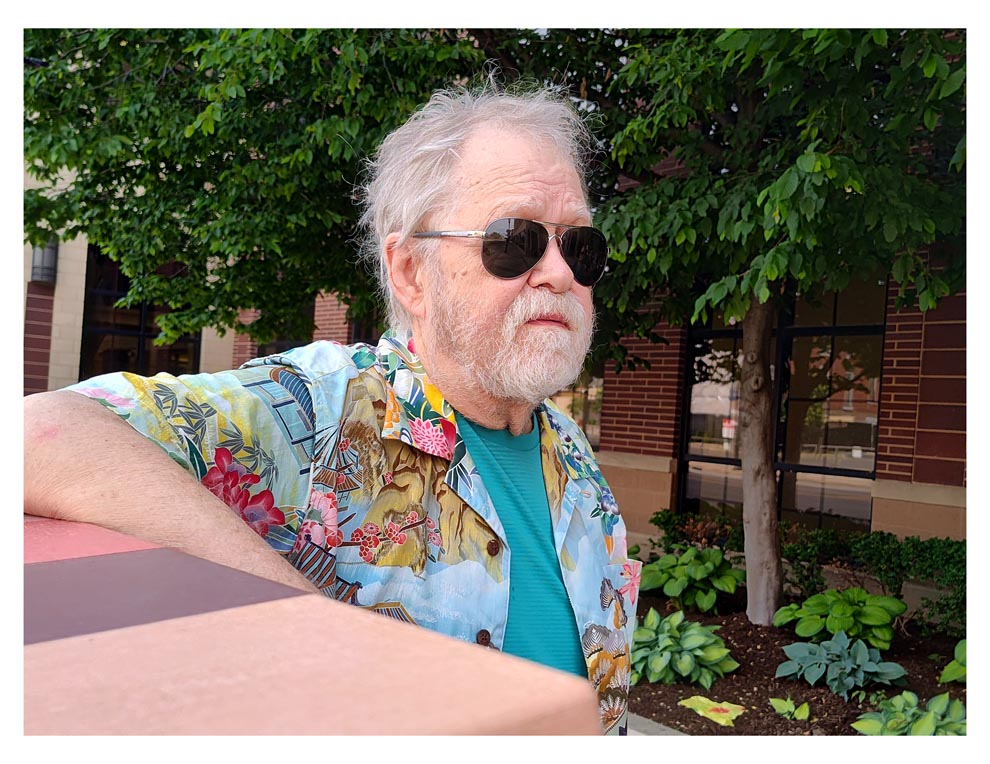
For Steve, the show might have been the Fox Valley giving him a little bit of love. He’s been involved in the local art scene since the late 1970s.
“I never really had a one-person show anywhere in Aurora. I always felt like Aurora never wanted to acknowledge my existence. I feel like the b@$% stepchild that moved into Aurora and no one wanted to acknowledge,” he said.
When I first interviewed Steve over the phone a couple of years ago, he was working on a large painting; he said it was about six feet tall. I asked him about his connection to the Aurora arts scene, and when it started.
Steve moved from Wheaton to Aurora in 1978 with his wife, Sally, and their young daughter. They bought a modest house at North May Street on Aurora’s West Side for just over $30K.
“We were pretty poor… I just got out of college. I was cleaning Marc’s Big Boy on Lake Street at night and painting during the day,” Steve said. He and Sally both went to Ball State University in Muncie, Indiana where Steve grew up before leaving for Wheaton, so that Steve could take classes at the Art Institute of Chicago. His father was also an artist.
He would take the train into the city where he got heavily involved in the Chicago art scene. He became a founder of West Hubbard Gallery, which was among the six art galleries that were part of the Hubbard Street gallery scene in the late 1970s and early 1980s. Steve called it “booming” and said they would get upwards of 2K people at art openings – usually held on first Fridays. “It was the hot spot in Chicago at that time,” he said.
“When I moved to Aurora, I didn’t want to be totally isolated, so I went out and found every artist I could find,” Steve said. Some of those artists were Steve Lowery, Dan Tutor, Mark Barens, and later Joe Hernandez when they were both teaching at Waubonsee Community College.
Lowery taught at Waubonsee Community College and Aurora University; Tutor was the director of Wedge Cultural Center for the Arts at 110 S. LaSalle Street; Hernandez taught ceramics at Waubonsee; Barens had a studio above Fox Valley Blueprint on River Street in downtown Aurora.
In 1988, Steve joined Barens in the Blueprint Studios. He rented three rooms next to Barens. “I would let everyone use the space; I would leave the key hanging so that anyone could use it,” he said.
He remembers there being more than a handful of studios above the blueprint shop. He kept art books in his studio and would host an open studio for art students. In the 1990s, he was joined by Josh Schultz, Sam Cervantes, Chryssa Gardiakos, and Bryan Danial Joseph among others.
“It was a cool place,” he said. They’d have art parties, and you’d go up to the studios using a side door. The studio doors lined a long hallway. According to Steve, the building had formerly been a bank and when they moved the bank vault, the building tipped a few degrees so it was slightly slanted.
Steve described Fox Valley Blueprint as a “shotgun” store with its narrow, deep interior. The front part served as an art supply store and blueprint machines were in the back part. It was later demolished to make room for Waubonsee’s downtown campus.
“That was an exciting time,” he said. “We were just trying to do whatever we could,” he added.
Steve kept active artistically in Chicago while continuing his local involvement.
“There wasn’t much in Aurora. We decided to do it ourselves,” he said.
In the mid-1980s, he was part of the Fox River Center for Visual Art at 14 W. Downer Pl. in downtown Aurora, but the center “couldn’t get traction from anybody.” Run by John Miller, a former Art Institute professor, the art center was a short-lived predecessor to something like Water Street Studios with both artist studios and art classes. “We could get no help from the city,” Steve said. Miller sold the building to its current owner and moved to Galesburg.
After Wedge Gallery and Fox River Center had both shuttered their doors, Steve became involved with Fox Valley Arts Council after he, Sally, and their now two children moved to Oswego in 1994. He would continue to do pop ups and group shows with some of the artists he befriended along the way.
Steve’s stories are plentiful and rich with insight about the Fox Valley art scene. He’s currently involved with organizing gallery shows in the role of director of exhibitions at Water Street Studios.
“I’ve done a lot of things. I’ve been friends with some pretty interesting people,” he said.
This past September, Steve was featured in a solo show at New View Art Space, in the Legal Arts Building at 122 W. Downer Pl. in downtown Aurora.
As I reread Steve’s artist statement, I found that the way he describes his style is also how he can define his life, “I move fluidly between mediums, treating each as an open-ended laboratory where form, image, and metaphor can emerge in unexpected ways.”
•Add these upcoming events to your calendar:
December 3 Community Voices in Conversation: Changemakers at Santori Library, Aurora
December 4 First Fridays, Aurora
December 11 The ArtBar at Sturdy Shelter, Batavia
Marissa Amoni has been championing local arts and culture for two decades. Follow her on Instagram
@marissashinesbright. View a calendar of local art events on alleyartaurora.com/artscene.