

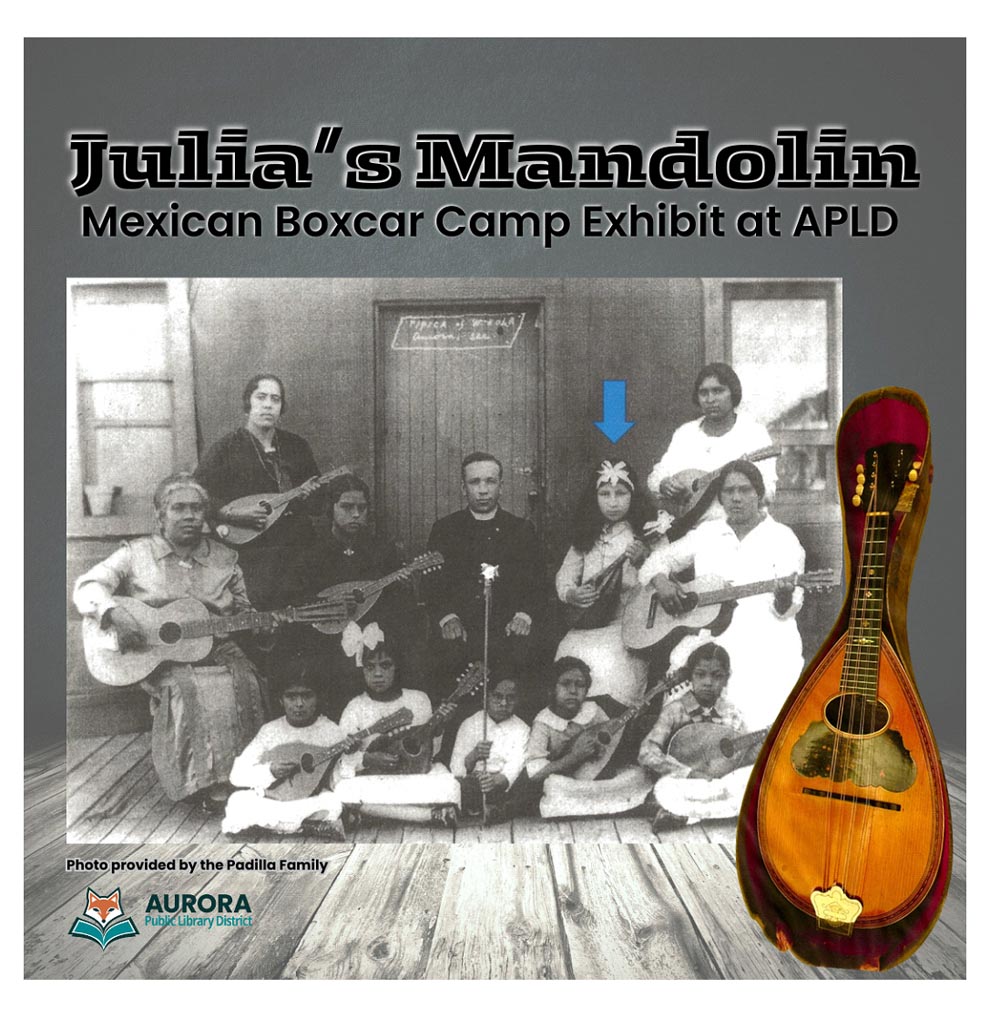

On a summer evening nearly one century ago, the sound of a mandolin floated across the Mexican boxcar camp in West Eola. Played by young Julia Pérez Padilla, the music carried through rows of families who had come from Mexico to work for the railroads in Aurora. Fast forward to today, Julia’s mandolin will return — not as an instrument of entertainment, but as a centerpiece of a new program and exhibition at the Aurora Public Library District, inviting residents to learn about an important chapter of Aurora’s history.
Curated by Auroran, Dr. Alejandro Benavides, the exhibition details the West Eola boxcar camp, where Mexican immigrants lived between the 1920s and 1930s while working for the Chicago, Burlington & Quincy Railroad. Viewers will step into that world through photographs, immigration documents, maps, and personal stories that trace how the first Mexican families established Aurora’s earliest Hispanic community. One highlight is a handcrafted 3D model train scene, built by Dr. Benavides himself, which recreates the camp and the metal reclamation yard. “I’m looking forward to the children’s excitement over seeing the train and learning about the people who are part of Aurora’s history,” said Dr. Benavides. This is a chance to see history come alive through both hands-on discovery and storytelling.
The accompanying program, Julia’s Mandolin: The True Story of a Mexican Boxcar Girl at 2 p.m. Saturday, Oct. 4 at the Santori Library, 101 S River St, Aurora, will go further and center on Julia’s story. Through Dr. Benavides’ research and the voices of Padilla family descendants, audiences will hear about her journey of immigration, family life, and music. Julia’s actual mandolin, the one seen in the 1930 photograph, will be on display. “My favorite part of planning this program by far was meeting Julia’s children and getting to hold her mandolin,” said genealogy and community history librarian, Cailín. “The image of her and the rest of the band with their instruments lives in the Community History Room where I work every day, so encountering the real-life object was a spectacular moment for me!” The mandolin and other artifacts from the time, like a framed lithograph that once hung at the chapel altar, connect today’s Aurora with the lives and faith of those early settlers.
By preserving and sharing the history of the Eola boxcar camp, Aurora gains not only a deeper understanding of its past, but also a renewed appreciation for the people whose labor and culture helped shape the city. “The lives of ordinary working-class women, especially women of color, have largely been undocumented and therefore left unknown,” added Cailín. “The telling of this local Latina woman’s story from Aurora’s first Mexican community is absolutely rare and precious. I’m so grateful to Dr. Benavides and Julia’s family for bringing it to light!”
The exhibition will be on display in the Santori Library Atrium and online through October 15 as part of Hispanic Heritage Month. Just as Julia’s mandolin once carried music across the camp, it now carries her story forward — inviting Aurora to listen, remember, and honor the community that helped build the city. For more information, visit www.aurorapubliclibrary.org/event/14413450 or contact the library at 630-264-4117.
Andrea Tiberi is the communications coordinator for the Aurora Public Library District.