

Data centers are a hot-button issue right now, but in reality, they are nothing new. If you’ve ever streamed a movie, accessed online banking, or made a video call, you’ve “used” a data center. Attention is currently focused on the number of facilities being constructed, how quickly they are going up, and the impact on our environment. Tuesday, Nov. 3, the Aurora Public Library District will dive into these concerns with a program titled Data Centers & Communities: Social & Environmental Impacts, where we will discuss infrastructure development and unpack community responses.
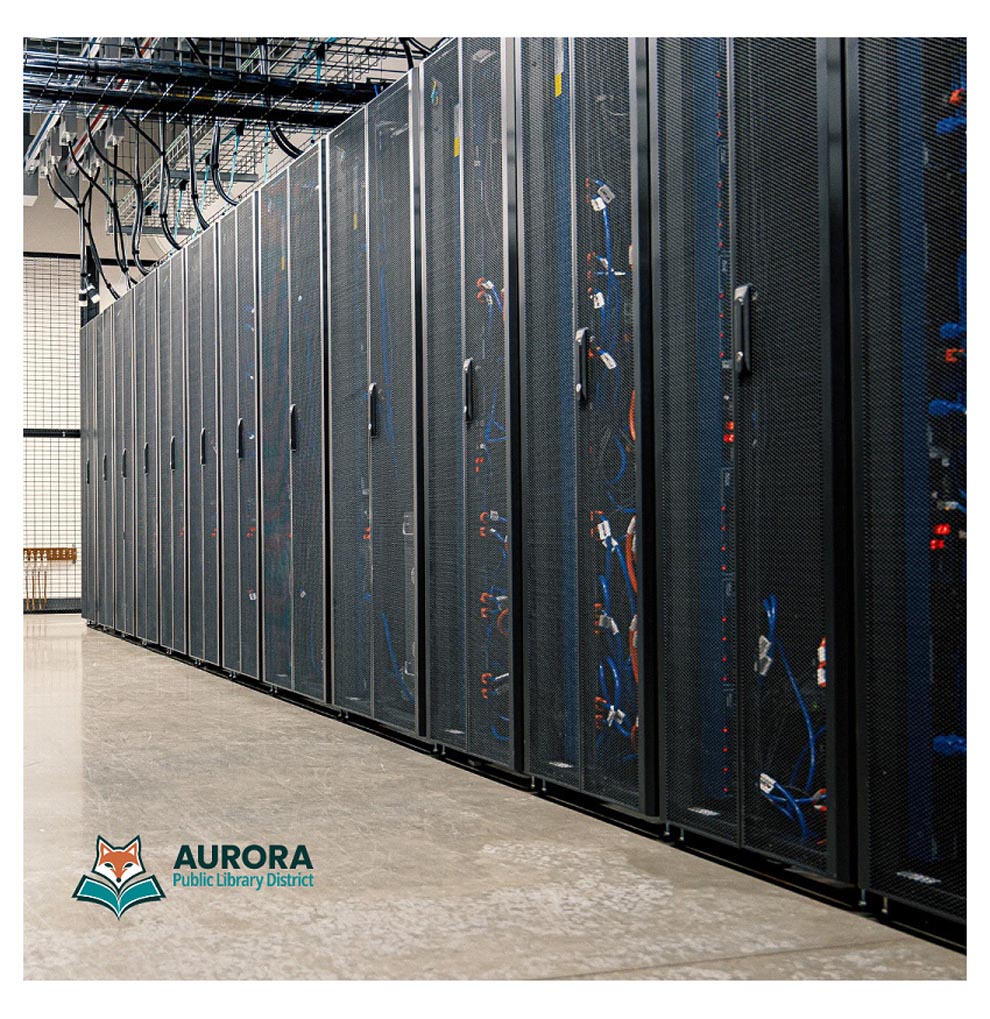
First, let’s talk about the functionality of data centers. A data center is a building that contains a large number of servers. Servers are specialized computers built to run 24/7 and store a large amount of information (data). We call upon these servers each time we perform a task that requires digital information to be sent from one place to another, like phone calls, streaming services, and internet searches. What’s changed in recent years is the increased use of AI (Artificial Intelligence). AI is only as ‘smart’ as the information it’s being trained with. If you want the most effective AI, you need to train it with more information, and to store that information, you need more data centers. “It’s important for everyone to understand the tangible, real-world effects of the AI boom,” said librarian Ethan. “Even if you don’t use AI yourself, the technology is undoubtedly impacting everyone’s lives.”
Here’s where the friction starts. These data centers take up hundreds of acres of space and use immense amounts of electricity and water. “Because there is currently no industry-wide regulation of data centers, the people who best understand the social and environmental impacts are those responding to and resisting developments in their home communities,” says Rachel A. Young our program presenter. Rachel is a PhD candidate at Loyola University Chicago in the School of Social Work. Her dissertation research examines community responses to digital infrastructure from an environmental justice perspective, focusing on the connections between our social, political, environmental, and economic systems.
As the demand for digital services grows, we become more dependent on these warehouses of digital data. But will the benefits gained from using AI outweigh the long-term effects? Find out more at 7 p.m. Tuesday, Nov. 3 at the Santori Library. This program will also be available to view virtually on Zoom. Visit www.aurorapubliclibrary.org/event/17194211 or call 630-264-4117 for more details.
AI was used in this article for brainstorming, outlining, and drafting support.
Andrea Tiberi is the communications coordinator for the Aurora Public Library District.